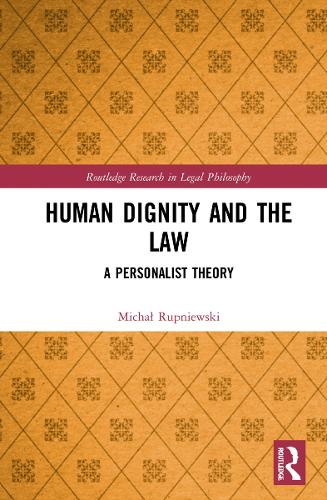
Human Dignity and the Law
A Personalist Theory This book reassesses the relationship between human dignity, law and specifically the ‘personalist’ school of agency. It will be of interest to academics and researchers working in the areas of Legal Philosophy, Jurisprudence, Philosophy, Ethics and Political Theory. This book reassesses the relationship between human dignity, law, and specifically the ‘personalist’ school of agency. The work argues that a specific way of appreciating dignity is contained in how law understands the person, and so can be used to improve upon how we explain and interpret the law. Despite considerable differences between jurisdictions as regards human dignity in application, it is argued that the particular weight of human persons is the widely shared focal point. The central claim, therefore, is that the law recognises, and tries to foster, the status of personhood, and, drawing on the work of Karol Wojtyła, the author develops a ‘Status of Personhood Theory’. The book will be of interest to academics and researchers working in the areas of Legal Philosophy, Jurisprudence, Philosophy, Ethics and Political Theory.
Product Information
Product Information
Shipping & Returns
Shipping & Returns
Description
A Personalist Theory This book reassesses the relationship between human dignity, law and specifically the ‘personalist’ school of agency. It will be of interest to academics and researchers working in the areas of Legal Philosophy, Jurisprudence, Philosophy, Ethics and Political Theory. This book reassesses the relationship between human dignity, law, and specifically the ‘personalist’ school of agency. The work argues that a specific way of appreciating dignity is contained in how law understands the person, and so can be used to improve upon how we explain and interpret the law. Despite considerable differences between jurisdictions as regards human dignity in application, it is argued that the particular weight of human persons is the widely shared focal point. The central claim, therefore, is that the law recognises, and tries to foster, the status of personhood, and, drawing on the work of Karol Wojtyła, the author develops a ‘Status of Personhood Theory’. The book will be of interest to academics and researchers working in the areas of Legal Philosophy, Jurisprudence, Philosophy, Ethics and Political Theory.