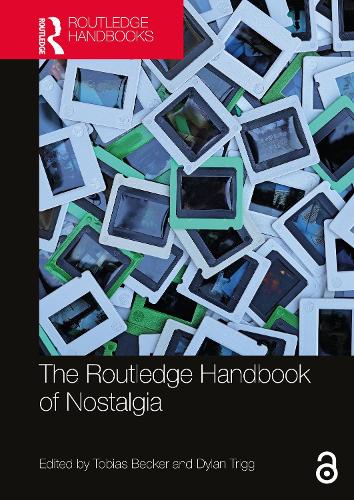
The Routledge Handbook of Nostalgia
The Routledge Handbook of Nostalgia serves as a guide to the complex and often contradictory concept of nostalgia, as well as the field of “nostalgia studies” more broadly. The Routledge Handbook of Nostalgia serves as a guide to the complex and often contradictory concept of nostalgia, as well as the field of “nostalgia studies” more broadly. Nostalgia is an area of intense interest across several disciplines as well as within society and culture more generally. This handbook brings together an international, interdisciplinary team of researchers to survey the current landscape and identify common trends, achievements, and gaps in existing literature. Comprising 45 chapters, the volume covers the following topics: Essential reading for students and researchers working in nostalgia studies, this book will also be beneficial to related disciplines such as philosophy, anthropology, geography, history, and literature; cultural, media, heritage, museum, and film studies courses; and more generally for readers interested in how the past is represented and used in the present. Chapter 18 of this book is freely available as a downloadable Open Access PDF at http://www.taylorfrancis.com under a Creative Commons Attribution (CC-BY) 4.0 license.
Product Information
Product Information
Shipping & Returns
Shipping & Returns
Description
The Routledge Handbook of Nostalgia serves as a guide to the complex and often contradictory concept of nostalgia, as well as the field of “nostalgia studies” more broadly. The Routledge Handbook of Nostalgia serves as a guide to the complex and often contradictory concept of nostalgia, as well as the field of “nostalgia studies” more broadly. Nostalgia is an area of intense interest across several disciplines as well as within society and culture more generally. This handbook brings together an international, interdisciplinary team of researchers to survey the current landscape and identify common trends, achievements, and gaps in existing literature. Comprising 45 chapters, the volume covers the following topics: Essential reading for students and researchers working in nostalgia studies, this book will also be beneficial to related disciplines such as philosophy, anthropology, geography, history, and literature; cultural, media, heritage, museum, and film studies courses; and more generally for readers interested in how the past is represented and used in the present. Chapter 18 of this book is freely available as a downloadable Open Access PDF at http://www.taylorfrancis.com under a Creative Commons Attribution (CC-BY) 4.0 license.