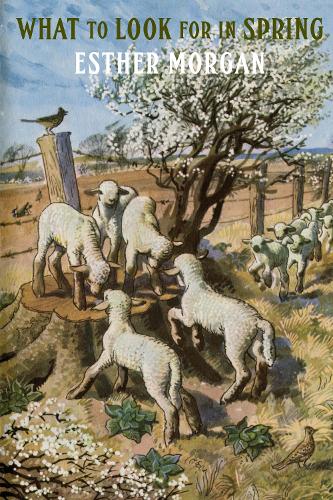
What to Look for in Spring
Esther Morgan’s What to Look for in Spring asks what ‘home’ might come to mean in a rapidly warming world where the ‘handful of birds and plants we know by name’ are already starting to disappear. The once commonplace sights and sounds of an English spring evoke the ghosts of Wordsworth, Hardy, Edward Thomas and others. Esther Morgan’s What to Look for in Spring asks what ‘home’ might come to mean in a rapidly warming world where the ‘handful of birds and plants we know by name’ are already starting to disappear. The once commonplace sights and sounds of an English spring evoke the ghosts of Wordsworth, Hardy, Edward Thomas and others in poems which also probe our nostalgia for a vision of England that ignores the class structures on which it was based. In one startling sequence the birds, trees and flowers of Browning’s ‘Home Thoughts from Abroad’ become prophets bearing witness against their fate. Other sources of inspiration include a set of vintage Ladybird books about the seasons and the Biblical story of Exodus as well as more personal reflections on the fragility of home seen through the lens of motherhood. Throughout, Morgan fuses tenderness and terror in poems which examine how climate change threatens to make migrants and exiles of us all. Set against this sense of rupture are two sequences based on the art of John Crome (1768-1821) and John Constable (1776-1837). Crome’s honouring of the overlooked in his Norfolk landscapes prompts an approach which offers a quietly radical alternative to click-bait and outrage. Constable’s famous sky studies by contrast are the springboard for poems as wake-up calls to the spirit – keen as an easterly wind or a dash of cold water to the face. In her fifth collection – her most ambitious and formally inventive to date – Esther Morgan extends her imaginative territory while retaining her lyric gifts to make home and its loss a tangible reality – piercing as the screams of swifts ‘like a fairground ride/on the other side of living’.
Original: $20.22
-65%$20.22
$7.08Product Information
Product Information
Shipping & Returns
Shipping & Returns
Description
Esther Morgan’s What to Look for in Spring asks what ‘home’ might come to mean in a rapidly warming world where the ‘handful of birds and plants we know by name’ are already starting to disappear. The once commonplace sights and sounds of an English spring evoke the ghosts of Wordsworth, Hardy, Edward Thomas and others. Esther Morgan’s What to Look for in Spring asks what ‘home’ might come to mean in a rapidly warming world where the ‘handful of birds and plants we know by name’ are already starting to disappear. The once commonplace sights and sounds of an English spring evoke the ghosts of Wordsworth, Hardy, Edward Thomas and others in poems which also probe our nostalgia for a vision of England that ignores the class structures on which it was based. In one startling sequence the birds, trees and flowers of Browning’s ‘Home Thoughts from Abroad’ become prophets bearing witness against their fate. Other sources of inspiration include a set of vintage Ladybird books about the seasons and the Biblical story of Exodus as well as more personal reflections on the fragility of home seen through the lens of motherhood. Throughout, Morgan fuses tenderness and terror in poems which examine how climate change threatens to make migrants and exiles of us all. Set against this sense of rupture are two sequences based on the art of John Crome (1768-1821) and John Constable (1776-1837). Crome’s honouring of the overlooked in his Norfolk landscapes prompts an approach which offers a quietly radical alternative to click-bait and outrage. Constable’s famous sky studies by contrast are the springboard for poems as wake-up calls to the spirit – keen as an easterly wind or a dash of cold water to the face. In her fifth collection – her most ambitious and formally inventive to date – Esther Morgan extends her imaginative territory while retaining her lyric gifts to make home and its loss a tangible reality – piercing as the screams of swifts ‘like a fairground ride/on the other side of living’.